Nero Wolfe's brownstone

>> Thursday, July 29, 2010


The Wolfe Pack, a Nero Wolfe fan group, placed this plaque near the spot where Nero Wolfe's infamous brownstone would have been located, had it been real. Unfortunately, author Rex Stout kept changing the address, and was never too concerned with where the actual address might be located. One of the possible locations, 922 West 35th, would actually lie somewhere in the Hudson River. Probably best that we go with 454 West 35th Street, then.

Picture via the LA Times.

Read more...

Gimme a Call Book Trailer

>> Wednesday, July 28, 2010


Check out the book trailer for my friend Sarah Mlynowski's Gimme a Call, about a woman who drops her phone into a fountain and fishes it out to find that it can only call her fourteen year old self. What would you say to your fourteen year old self if you could call him/her right now?

Read more...

God Hates Jedi

>> Tuesday, July 27, 2010


San Diego Comic Con happened last weekend, and once again, I wasn't there. (Boo.) Tons of tons of fanboys and fangirls were though, as were a few idiot protesters there to tell all the revelers they were going to hell and that God hates them:


Word had gotten around that these jokers would be protesting though, and the Comic Con faithful responded in overwhelming numbers, forming a mob of their own to protest the protesters!


I love the total randomness of the signs and costumes, a real testament to the way the various fandoms all come together to revel in their respective geekeries at events like this and DragonCon, our annual geek-family pilgrimage.


Jesus, letting everyone know the real deal.


And yeah, seriously, how the #?*! do they work!?

Read more (and see more pics) at Comics Alliance. Rock on, geek nation.

Read more...

This season's book cover fashions

>> Monday, July 26, 2010


Over at PW's Shelf Talker blog, author, bookseller, and industry blogger Elizabeth Bluemle has a great feature on current fashions in book cover design, presented as though they're coming down the runway. Above, the trend for period costumed girls coming and going in mysterious poses...


...a spate of key covers...


...and girls with straight hair sweeping over their faces. I'm always fascinated by book covers--so much thought and time goes into their design that the end results really are worthy of study. Click on over to the Shelf Talker blog to see more.

Read more...

Fun with Tesla coils

>> Friday, July 23, 2010


Ahhhh! Oh my gosh, I love this so much. I found this while doing a bit of research on Tesla coils for my current work in progress. (I swear! I was working!) I'm a big fan of the many, many renditions of the Mario Bros. theme played on various instruments that are posted to YouTube, but this one may take the cake.

How's it done? Here's what Wikipedia says:

Tesla coils can also be used to create music by modulating the system's effective "break rate" (i.e., the rate and duration of high power RF bursts) via midi data and a control unit. The actual midi data is interpreted by a microcontroller which converts the midi data into a PWM output which can be sent to the tesla coil via a fiber optic interface.

I have no idea what all that means. THEY CAN MAKE THEM PLAY MARIO BROS. That is all that matters. And the same electro-wizardry allows them to play lots else besides. I cried when I watched this next one reach its climax. Hang with it past the "tune up" testing. There's also a treat after the first song...


And here's one more for you:


Ahhhhhh! I love science.

Read more...

Japan Trip - Kyoto Day 5 - Kinkakuji Golden Temple

>> Thursday, July 22, 2010


On our last day in Kyoto, we bowed to the guidebooks and hit a couple of the "can't miss" historical sites, including this one--Kyoto's famous Kinkakuji Golden Temple. It really is pretty magnificent.


One of 17 World Heritage Sites in Kyoto alone, Kinkakuji (which translates as the very Indiana Jones-sounding "Temple of the Golden Pavilion") was originally the villa of a powerful statesman. In 1397 it was bought by the shogun, and upon his death it was dedicated as a Zen temple, per his last wishes. The whole complex was burned to the ground in the 1400s during the Onin war, and it again burned to the ground in 1950 when a mentally ill monk set fire to the place. The current building dates from 1955, when it was rebuilt.

The top two stories are covered with gold leaf, and the building supposedly houses some of Buddha's ashes. Each floor has a different architectural style, the first two with (building on a theme here) Harry Potter-ish names: The first floor is The Chamber of Dharma Waters, the second floor is The Tower of Sound Waves. The third has no cool name, but is topped with a bronze phoenix, which fits our theme nicely.


The temple sits at the edge of a beautiful Japanese garden. The pond is known as the Mirror Pond, and does, in fact, offer pretty stunning mirror images of the Golden Temple. (None of which I was able to capture very well.)


The rest of the grounds were built according to the descriptions of the Western Paradise of the Buddha Amida, meant to demonstrate the harmony between heaven and earth. The largest islet in the pond (not this one) represents the Japanese islands. The four stones forming a straight line in the pond near the pavilion are intended to represent sailboats anchored at night, bound for the Isle of Eternal Life in Chinese mythology.


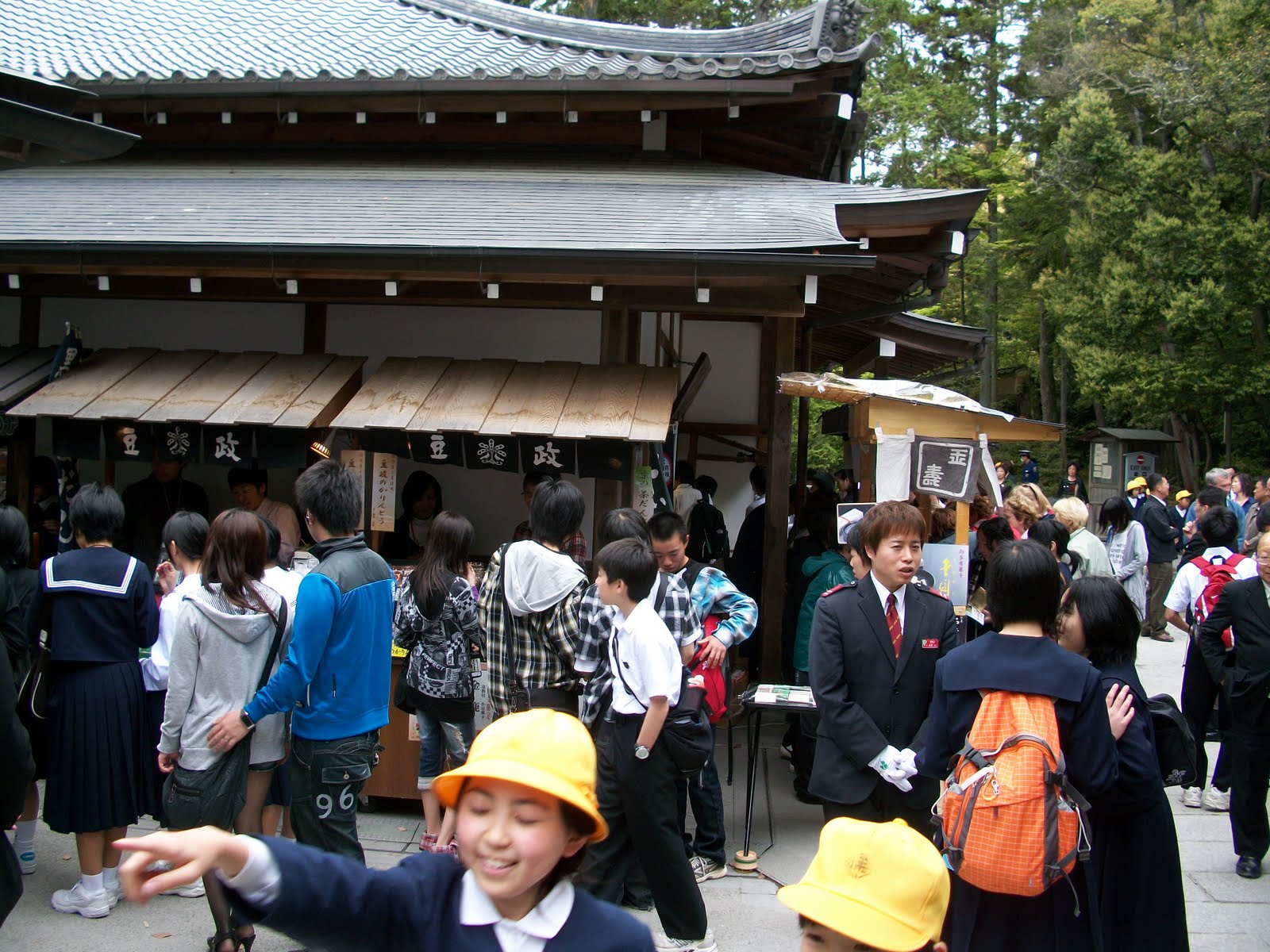
The problem is, this is about as close as you ever get to the temple, and you definitely don't get to go inside. We didn't, at least. And when the guidebooks tell you Kinkakuji "attracts a large number of visitors annually," they aren't kidding. There must have been thousands of other visitors there with us, with room, comfortably, for only hundreds.

When you enter, you're set off on a path that moves around the far side of the pond, with varying views of the temple through the trees. The best places to view the temple are absolutely jam-packed--so much so that you can barely move--and it's impossible not to be jostled and squeezed with no regard whatsoever for personal space as though you're on the Yamanote line during morning rush hour. Despite the beauty across the river from us, the rest of our visit was terribly unpleasant.


Adding insult to injury, it costs each of us 400 yen (about $4.00) to enter for what amounted to a highly contested photo shoot. Admittedly, that's mostly what we do at attractions like this, take lots of pictures, but we're a family that likes to learn something and have some kind of cultural experience along with our photo ops, thank you very much, and that wasn't the case here. Everything I've told you about the history and significance of the place I found on the Internet or in the guidebook later. The temple complex is all about getting your money, herding you quickly down the path, and getting you to drop some hard money at the inevitable temple souvenir shops at the end.


The top of the temple from the latter half of the path. Again, the place is gorgeous, but what you don't see here are the hordes of people I had to wrestle out of the way to get this picture. It helped that I was usually a bit taller than the average crowd in Japan.


It was so crowded, there was an embargo on tripods--a sign which, in a land otherwise mad for restrictive signs, we had never seen before. This one at least we agreed with. If you let people set up tripods around this place, you would never, ever be able to move. And believe me, if they didn't prohibit them, Japanese photohounds would have them set up all over the place.


And then there was the madhouse souvenir area, selling all kinds of Buddhist charms...


...snacks...


...and fortunes. Love the signage here: "Hard money, 100 yen, pay down." The unintended tone matched our impressions of the place entirely.


Best of all, perhaps, was the specially labeled "Fortune dust-can," where you're supposed to throw away your fortunes after you've read them. Our final impression about Kinkakuji: exquisitely beautiful from afar, but we could have saved ourselves a lot of time, trouble, and money if we had all just bought postcards of the place and spent the morning somewhere else.

(BTW: this marks our 1,000th post at Gratz Industries! Cheers, and thanks for reading!)

Read more...

The Fantasy Baseball cover!

>> Wednesday, July 21, 2010


Behold! The cover of my new middle grade novel, Fantasy Baseball, due out in March 2011. (Click on the picture to see it a bit larger.) The artwork is done by the fabulous Greg Call, who also did the covers for Peter and the Starcatchers, Up and Down the Scratchy Mountains, and many more. Advanced Reader Copy giveaway coming soon!

EDIT: I suppose I ought to say what this book is about, if I can. Here's the elevator pitch I've been working on for it:

Fantasy Baseball is the story of sixth grader Alex Metcalf, who must figure out if he himself is real when he wakes up in a fantasy world filled with famous characters from children's literature like Dorothy from The Wizard of Oz and Toad from The Wind in the Willows, all of whom are playing in a huge baseball tournament.

(The elevator pitch is a work in progress...)

Read more...

Star Wars on the subway

>> Tuesday, July 20, 2010


Saw this on Bookshelves of Doom, and had to repost it here. People like this make the world awesome.

Read more...

Authors: Don't do this.

>> Monday, July 19, 2010

Foolish authors on the Internet, installment #392: Historian Orlando Figes, a professor of history at Birkbeck, University of London, has copped to posting critical reviews of his scholarly rivals on Amazon, while at the same time posting what he thought were anonymous positive reviews of his own work.

When the maligned authors called on him to come clean, he got litigious. I suppose when he realized that if things actually went to court he'd be busted, so next he laid off the blame on his wife, who, he said, had done all the flaming. In April though, he admitted that wasn't entirely true either. From the Guardian article:

In a statement released on 23 April Figes admitted "full responsibility" for the posts, saying he had been under "intense pressure". He said: "I have made some foolish errors and apologise wholeheartedly to all concerned."

Foolish errors. No kidding.

As part of the agreed settlement Figes, who has been on sick leave since the scandal broke, has circulated an apology and retraction. Figes and his wife also agreed to pay his fellow historians damages and legal costs, and promised not to repeat the allegations or post further anonymous reviews of their works.

Authors, seriously: Don't be a prat. The Internet is watching.

Read more...

Japan Trip - Kyoto Day 4 - Fushimi Inari Taisha

>> Thursday, July 15, 2010


On the outskirts of Kyoto lies Fushimi Inari Taisha, an incredible shrine with thousands of torii (Shinto gates, like those above) that was one of the highlights of our trip to Japan.


The closest station was a 20 minute ride outside downtown Kyoto, and was trimmed with orange, no doubt in honor of the orange torii we were about to see.


The entrance gate. This torii is said to have been placed here by Toyotomi Hideyoshi, the 16th century successor to the first Japanese Shogun, Oda Nobunaga. The shrine itself was originally built southwest of here in 711, but was moved to its present location in 816.


As with many religious sites in Japan, there is a healthy commercial aspect. Down this side road, through another torii, are shops selling souvenirs of the place, as well as tokens and charms touting a variety of benefits.


The main structure here at the base of the mountain was built in 1499.


The shrine is dedicated to the kami Inari, who also lends his name to the mountain. Inari is the Shinto god or spirit of fertility, rice, agriculture, foxes, industry, and worldly success. This odd mixture means that fox statues abound, often with sheaves of rice in their mouths, and that rice offerings like sake and rice cakes are left at many altars up and down the mountain.


This kitsune (fox) holds the key to a rice granary, although he doesn't look like he's about to give it up.


The industry and worldly success angle of Inari is what is responsible for the estimated 10,000 brilliant orange torii that line the circuitous path up and around the mountain. Corporations buy these torii and have them placed here as offerings to Inari, to insure worldly success. Each of the torii is only here for a few years, and is then replaced. The names of the sponsoring corporations are the words written on the posts from the top down.


The two torii in the middle here are older, and will be replaced soon. Some are even rotting, but most are shiny and new.


The day we went was overcast and drizzly, but nothing much could dampen the strange beauty and otherworldly nature of this place.


The paths stretch for four kilometers up and around the mountain, and take around two hours to walk.


At the end of the path is a neat double path of torii.


Along the way are small pockets of shrines dedicated to Inari, creating peaceful places to stop, stroll, and sit.


Smaller torii are left all over the place by both businesses and individuals, with hand-written requests for happiness and success.


The bells can be shaken to wake the spirits. We woke up a few along the way--I hope they weren't mad that we interrupted their naps!


We thought about leaving a torii ourselves, but those things are expensive! These were among the cheapest--about $25 and $35 dollars apiece! Larger personal torii could get as expensive as $100. Worldly success doesn't come cheap...


Some smaller torii left with English wishes on them.


A smaller shrine along the path.


One of our favorite little pockets along the way. This little side path went just a few meters around the corner, and had a small waterfall of its own.


Me looking out at Wendi and Jo, with my back to the waterfall. The place was so small it was hard to get a picture looking in.


Another tiny shrine.


Nothing is truly sacred in Japan, it seems. You can pull your motorcycles right up and have shrine-side parking!


A pretty view along the way.


At certain places along the path there are rest areas that sell food, drinks, and personal torii.


We stopped at this one so Wendi could have inari-zushi, a sushi roll of fried tofu that was said to have originated here, hence its name. The fox spirits here are said to love the stuff. Wendi found it...less than impressive.


This restaurant afforded pretty impressive views of Kyoto below, though our view was somewhat obscured by the cloudy day.


I think this is a dog, not a fox. Unless it's a fox who's had too much inari-zushi.


The occasional gaps in the string of torii were often just as beautiful as the string of gates.


A fox fountain.


A rainy but fabulous morning at Fushimi Inari, definitely a must see if you go to Kyoto.

Read more...
Related Posts with Thumbnails
Read Alan's archived newsletters here.

Blog Archive

Swell Stuff

My Etsy Favorites

  © Blogger template Simple n' Sweet by Ourblogtemplates.com 2009

Back to TOP